The European ALARA Network

The European ALARA Network (EAN) promotes the optimisation of radiation protection (keeping exposures As Low As Reasonably Achievable – ALARA) across Europe. It brings together professionals, regulators, and stakeholders to share experience, develop guidance, and support the practical implementation of ALARA principles in various sectors, including industry, medicine, research, and the environment.

Radiation protection of aircraft crew

Between December 2010 and January 2012, EAN performed a survey about radiation protection of aircraft crew. The following questions were sent to the members of the network.


1. Is there a regulation concerning radiation protection requirements for aircraft crew in your country?
2. If yes:
  • What are the main requirements?
  • What are the means and tools used to assess aircrew’s exposure?
  • Is there a specific dose criteria defined for aircraft crew?

3. Could you provide data on the number of aircrew exposed, maximum annual level of exposure, average annual level of exposure, etc.?

14 countries answered the request about radiation protection of aircraft crew: Belgium, Czech Republic, Denmark, Finland, France, Germany, Greece, Ireland, Italy, Lithuania, Slovenia, Sweden, the Netherlands and the UK. There is not a regulation concerning radiation protection requirements for aircraft crew in Norway.

Download the results of the survey: icon Aircraft crew

Read more

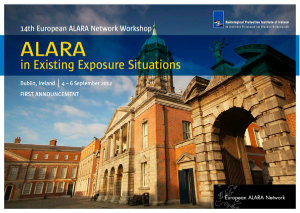
14th EAN Workshop on « ALARA in existing exposure situations »

14th European ALARA Network Workshop, Ireland 4-6 September 201

« ALARA IN EXISTING EXPOSURE SITUATIONS »

The concept of “existing exposure situations” was introduced by ICRP in Publication No. 103 (2007), and is included in the revised European Basic Safety Standards Directive. It is defined as exposure situations that already exist when a decision on control has to be taken, such as those caused by natural background radiation and radioactive residues from past practices or events.  Examples include radon in dwellings and buildings with public access, building materials and management of contaminated areas from past practices and post-accidents. Other situations such as exposure from cosmic rays and NORMs may also be included.

Optimisation is the key radiation protection principle for existing exposure situations, although it is not always clear how to apply this in practice.  Consequently, the aim of the 14th EAN workshop is to focus on how the ALARA principle can be applied to the whole range of existing exposure situations.  The Workshop will consider the wider principles and strategies that might be adopted, as well as the specific methods for implementing ALARA in practice.

This workshop will consist of presentations intended to highlight the main issues, and a significant part of the programme will be devoted to discussions within working groups.  From these discussions, participants will be expected to produce recommendations on ALARA in existing exposure situations addressed to relevant local, national and international stakeholders.

Working Group Topics

  1. ALARA challenges and practicalities at the national and regional levels
  2. Considerations in choosing reference levels
  3. Economical, technical factors and endpoints of optimisation
  4. Societal factors and stakeholders engagement
Read more