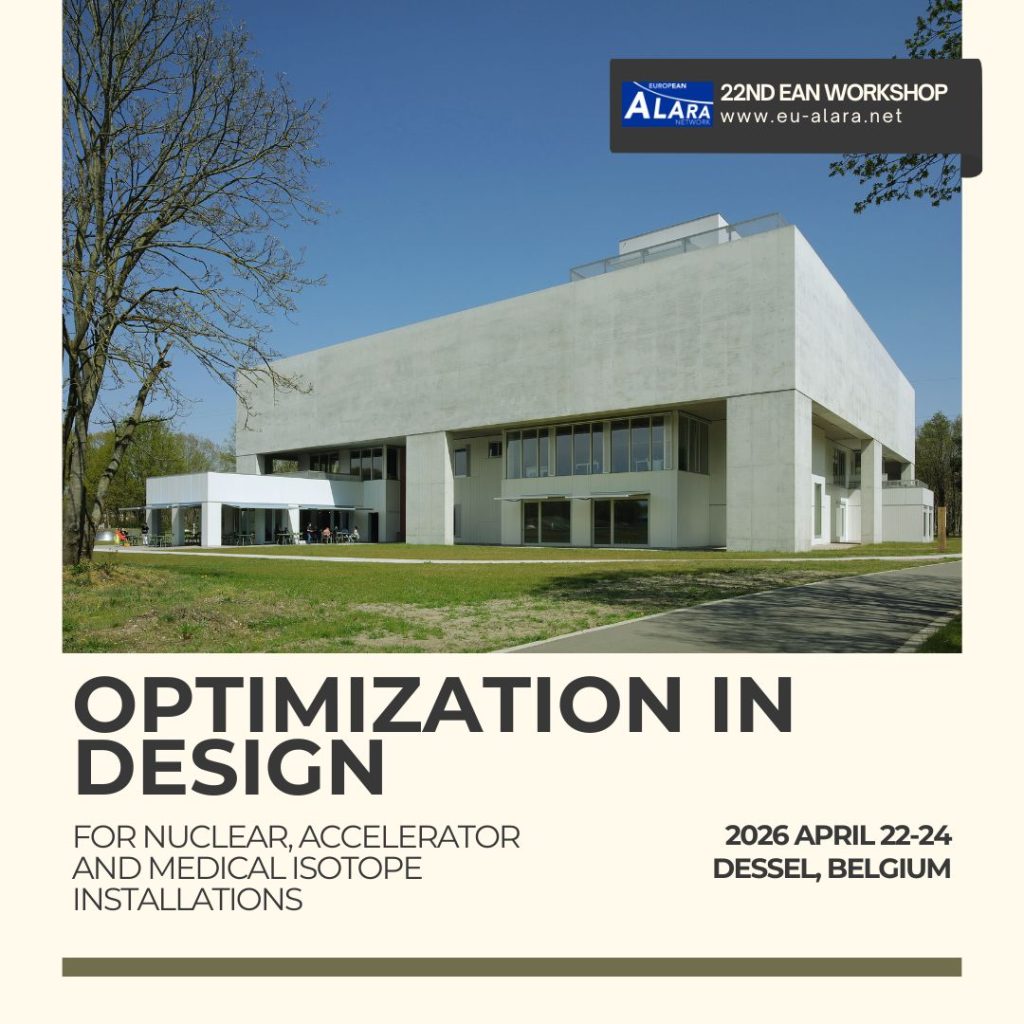
EAN’s 22nd Workshop heads to Belgium in April 2026!
21st EAN Workshop – Optimization of the transport of radioactive material
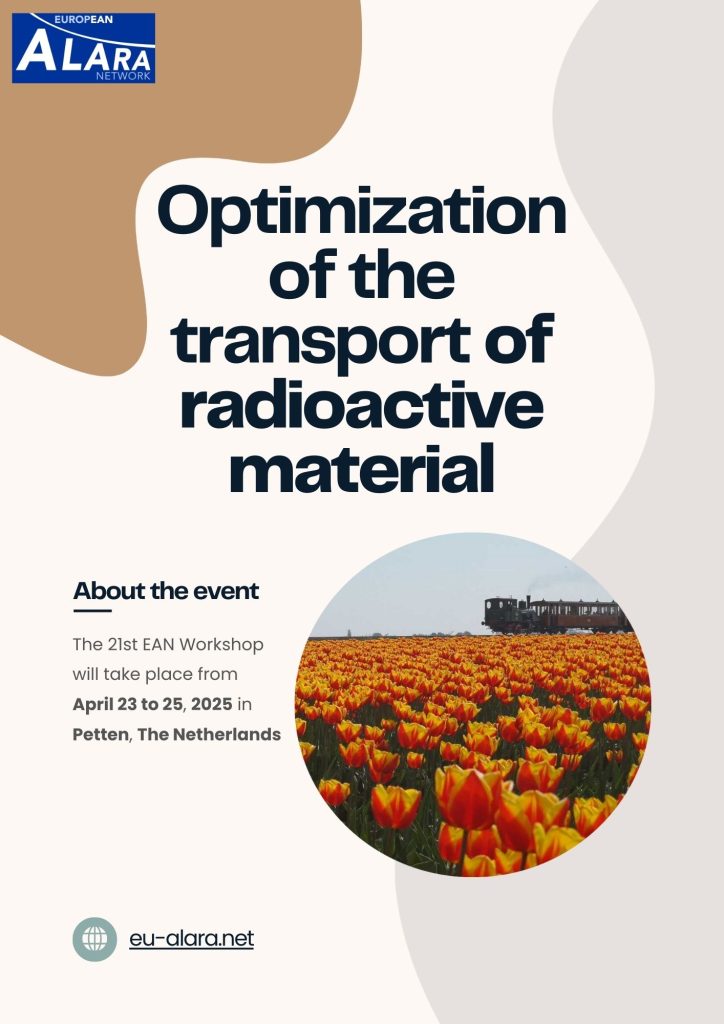
The 21st EAN Workshop on the Optimization of the transport of radioactive material took place from April 23 to 25, 2025 in Petten, The Netherlands.
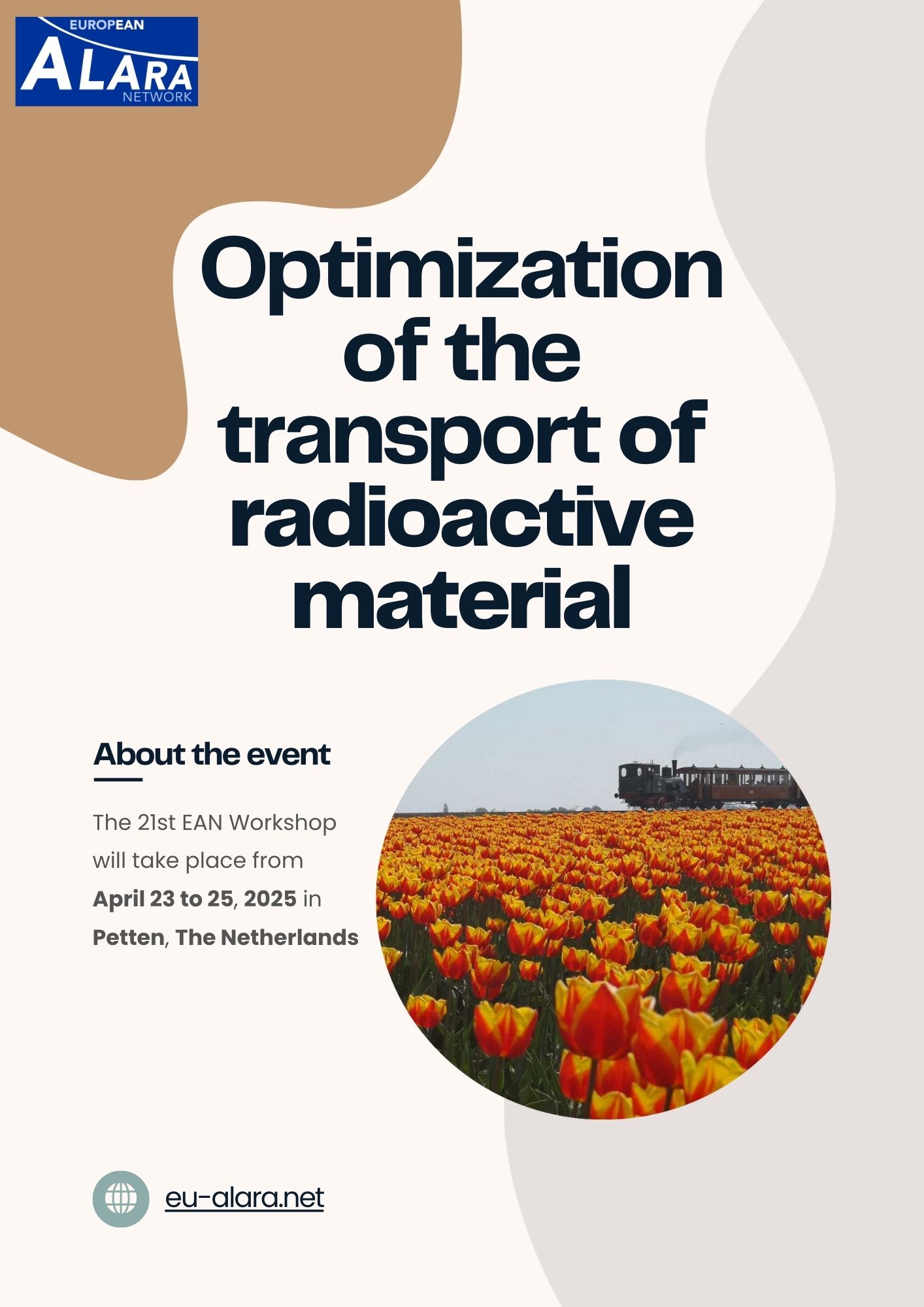
Find the program and the presentations below.
20th workshop: ALARA for interventional radiology & nuclear medicine
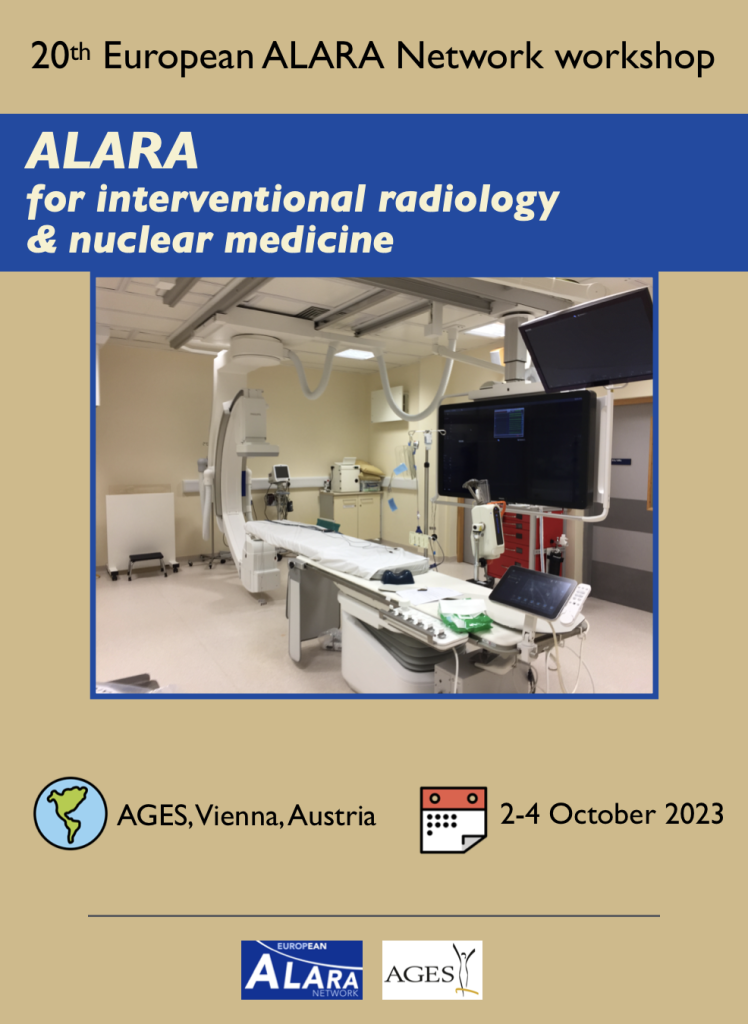
EAN 20th workshop ALARA for interventional radiology & nuclear medicine
Vienna, Austria, 2-4 October 2023
Workshop 19′ (webinar) « Challenges in applying the radiation protection system in the management of NORM and radon », online, 8 December 2022
WHY THIS TOPIC? — The International Commission on Radiological Protection system of protection is based on three fundamental principles: justification, optimisation and dose limitation; they apply to three types of situations of exposure to ionising radiations: (those that can be) planned, (in case of) emergency and existing (from sources that already exist when decisions to control them are made) along with three categories of exposures: occupational (i.e. workers), medical patients and the public (ICRP, 2007, ICRPedia).
Radon and NORM (naturally occurring radioactive materials) exposures have been categorized by ICRP as existing exposure situations (ICRP 2014; 2016; Lecomte, 2016; ICRP, 2019). However, both types of sources present specificities, making the choices about the type of exposure situation and the categories of exposure somewhat challenging and areas of confusion [Cool, 2013]. In some circumstances (for example in [Euratom, 2013]), radon and NORM are considered as planned exposure situations and exposure controlled as such. ICRP has recognized that further clarity is needed on the interpretation of exposure situations [Clément, 2021].
ICRP has insisted that the optimisation principle is a systematic process that apply irrespectively of the exposure situation: fundamentally, the exposure of the individuals should always be kept ALARA below certain dose criteria, be it called “reference level” or “dose constraint” depending on the case. Nonetheless, the protection strategy should be designed based on the characteristics of the situation and the circumstances of the exposure and a graded approach might be appropriate.
The application of the optimisation principle is the cornerstone of the activities of the European ALARA Network. Furthermore, the EAN also aims to assist ICRP in the practical implementation of its recommendations and to monitor the development of the new general recommendations [EAN, 2021], as a Special Liaison Organisation.
19th EAN Workshop « Innovative ALARA Tools »
! 2 workshops in 1 !
PODIUM Dissemination workshop and EAN 19th workshop Innovative ALARA Tools
Athens, Greece, 26 and 27 – 28 November 2019
18th Workshop: ALARA in Decommissioning and Site Remediation
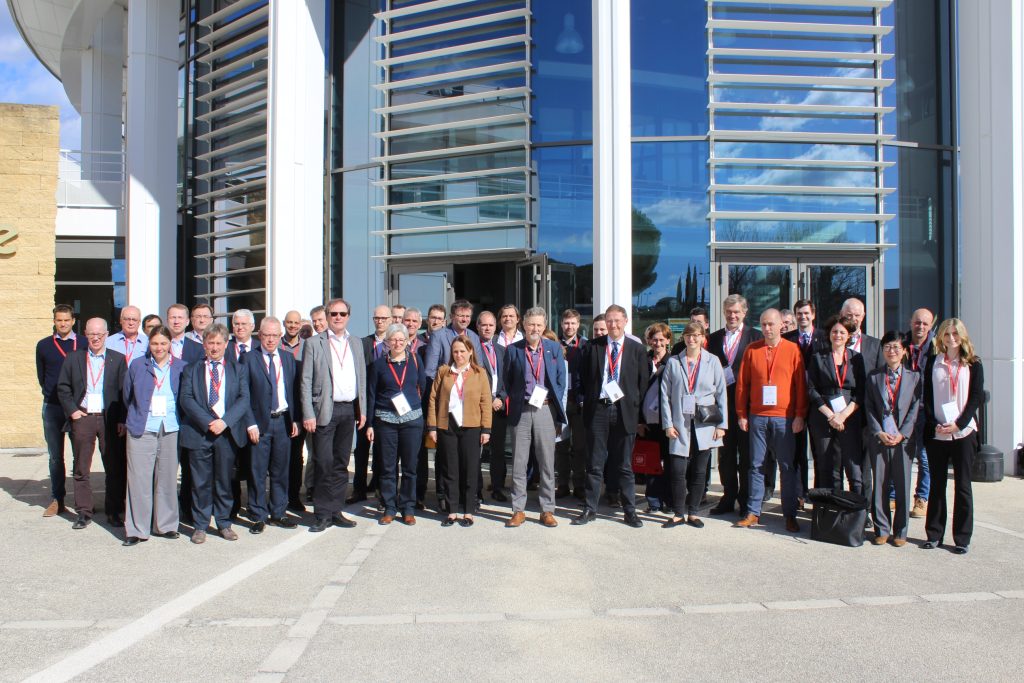
18th European ALARA Network Workshop [organized in collaboration with ISOE], Marcoule, France, 11 – 13 March 2019
« ALARA in Decommissioning and Site Remediation »
____
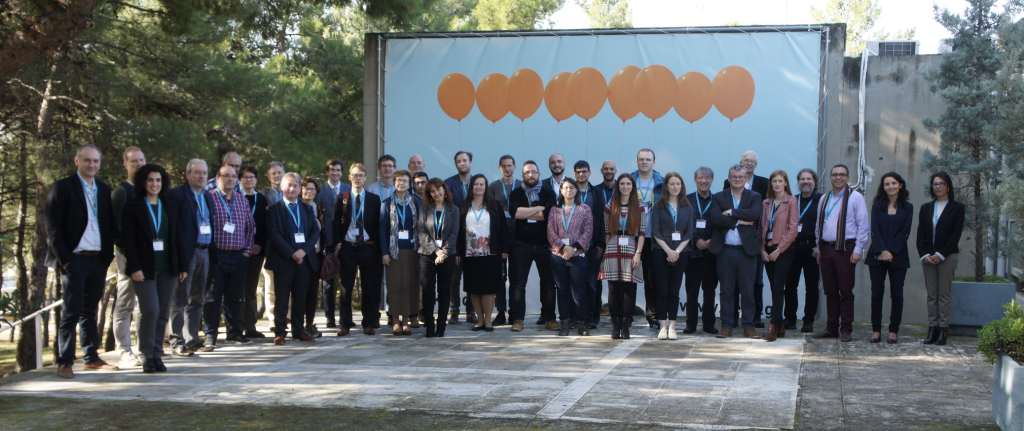
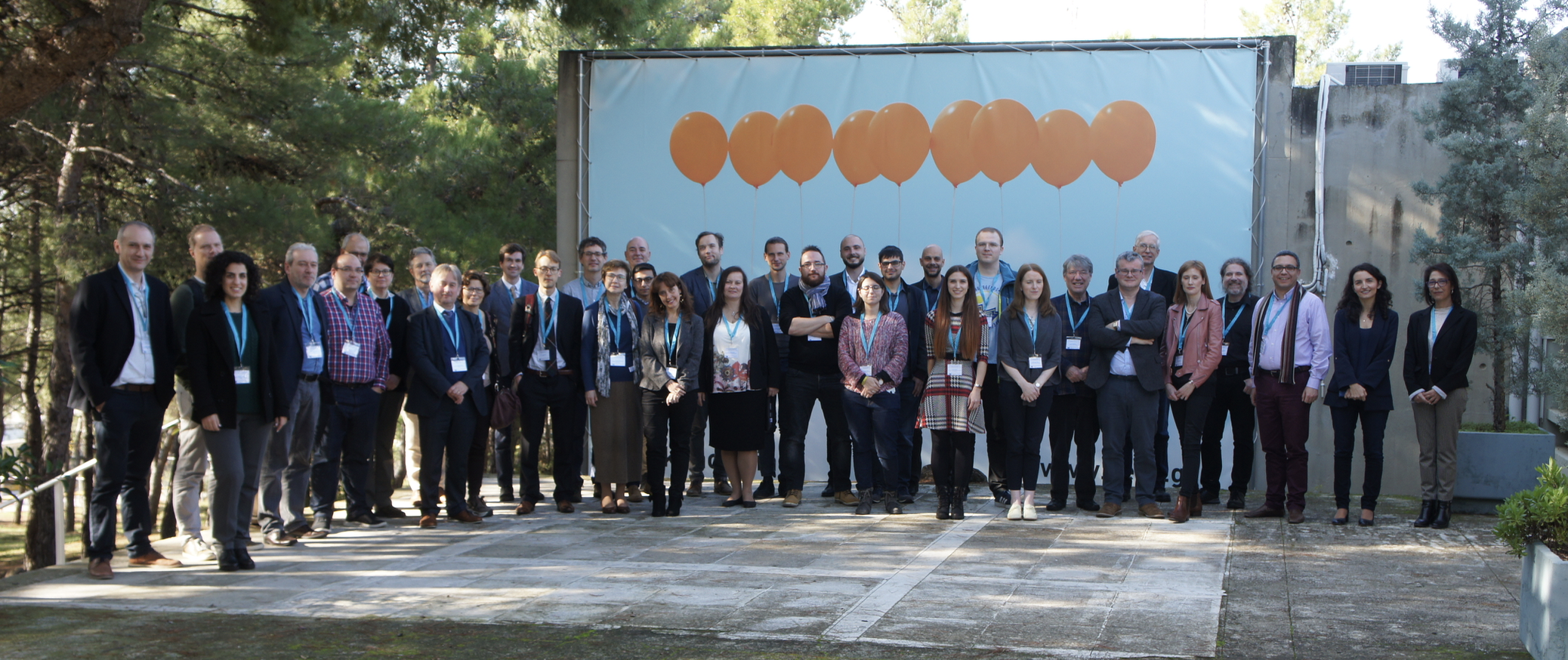
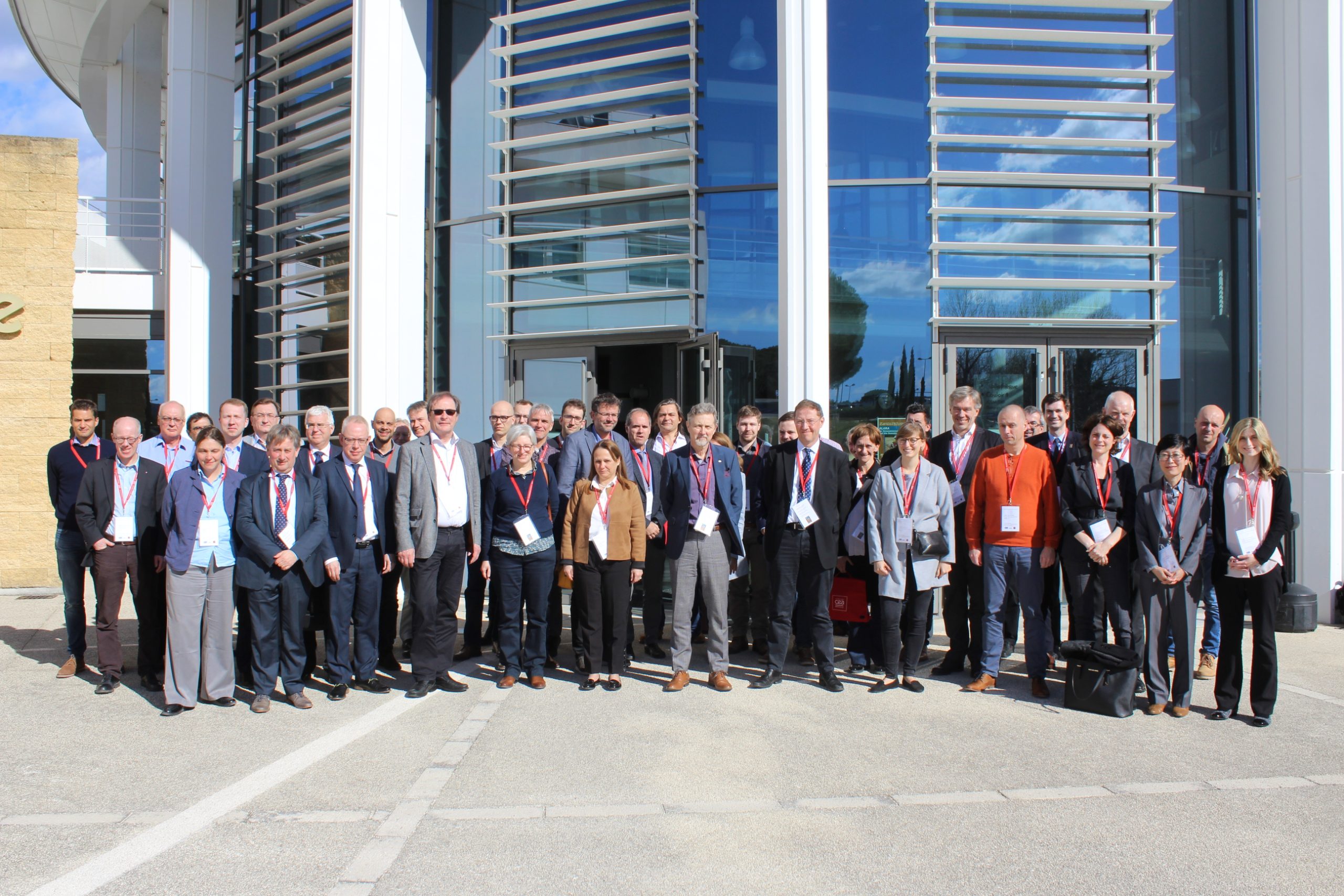 The participants (ICSM Marcoule, 11th March 2019).
17th European ALARA Network workshop on « ALARA in emergency exposure situations »
17thEuropean ALARA Network Workshop [organized in collaboration with NERIS], Lisbon, Portugal, 15 – 17 May 2017
« ALARA in Emergency Exposure Situations «
16th EAN Workshop on « ALARA in Industrial Radiography »
16th European ALARA Network Workshop, Berne, Switzerland, 14 – 16 March 2016
« ALARA in Industrial Radiography – How can it be improved? »
15th EAN Workshop on « Improving ALARA Culture through Education and Training »
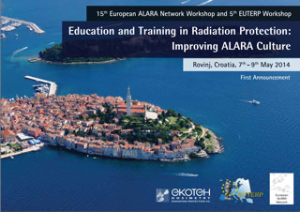
15th European ALARA Network Workshop, Rovinj, Croatia, 7 – 9 May 2014
« Education and Training in Radiation Protection
Improving ALARA Culture through Education and Training »
Aims and Objectives
Previous EAN and EUTERP workshops have noted the importance of delivering effective radiation protection education and training to workers and other stakeholders. Consequently, this joint EAN-EUTERP workshop considers how education and training programmes can be delivered effectively, to improve radiation protection in practice and disseminate ALARA culture.
The workshop will consist of presentations (oral and posters) intended to highlight the main issues, and a significant part of the programme will be devoted to discussions within working groups. Participants will be expected to produce recommendations on education and training issues, to be addressed to relevant local, national and international stakeholders
Scope of the Workshop
The workshop programme covers education and training for various types of stakeholders and is expected to consider the following subjects:
- The new European BSS
- European qualification and accreditation schemes (ECVET, EQF, etc.)
- The effectiveness and efficiency of education and training
- Practical ALARA training
- New learning tools
Working Groups
As part of the programme, time has been devoted for discussions between participants (divided in four working groups). The working groups have tackled issues such as :
- How to assess the effectiveness of training (WG1)?
- Tools to improve the effectiveness of training (WG2).
- What is achieved by recognition schemes (WG3)?
- Incorporating ALARA culture in training requirements – How to improve risk awareness, radiation protection and ALARA understanding for different stakeholders and different levels of exposure (WG4)?
Presentations
Session 1 – Setting the scene
- Welcome address to European ALARA Network and EUTERP Workshop on Education and Training in Radiation — F. Vermeersch
- Education and training in radiation protection: initiatives of the EUTERP Foundation — R. Paynter
- Education and training in radiation protection in the European Basic Safety Standards — G. Simeonov
- Conclusions & Recommendations by the HERCA Task force on Education & Training in Radiation Protection — T. Vermeulen
- ENETRAP III — M. Coeck
- IRPA Guiding Principles for Establishing a RP Culture — C. Schieber
- Recent Developments within the European Framework of RP Education and Training — A. Schmitt-Hannig
Session 2 – Building ALARA into radiation protection training programmes
- Optimization of radiation protection (ALARA): a practical guidebook — C. Schieber
- Reflections on ALARA in RP training — F. Vermeesch
- Elaboration of training scheme on radiation protection of patients: The French experience — C. Rousse
- Exercising Radiation Protection Planning as a Relevant Course Content for Training ALARA — G. Jahn
- Introduction to Working Groups — P. Shaw
Session 3 – Measuring the effectiveness of training, the role of qualification and recognition schemes
- Assessing the effectiveness of training – what are we looking for? — J. Stewart
- How to test the effectiveness of training? — E. Grindrod
- Teaching radiation protection principles – Possibilities for more effective approach — M. Koželj
Session 4 – Tools and methods
- The use of computer simulations in specific job training, risk communication and safety — F. Vermeesch
- Serious 3D Game for education and training in radiation protection — movie — A. Pin
- How to integrate the « Humans factors » within a reviewing project of the HP training for outside workers — I. Fucks
Session 5 – National approaches
- Education and Training System in Croatia (Case Study) — D. Posedel
- Greek Atomic Energy Commission initiatives with respect to education and training of outside workers — C. Pafilis
- RP Education and Training in Germany in the light of the new EURATOM BSS — J. Vogel
- Challenge of implementing RPE RPO in Belgium Guidance document — P. Froment
Session 6 – Working Group conclusions and Workshop synthesis
- Group 1 “How to Assess the Effectiveness of Training” — WG1
- Tools to improve the effectiveness of training — WG2
- WG3. What is achieved by recognition schemes? — WG3
- Incorporating ALARA culture in training requirements — WG4
- EUTERP Conclusions
- Conclusions and recommendations — P. Shaw
- Conclusions and recommendations (in Swedish) — M. Andersson
14th EAN Workshop on « ALARA in existing exposure situations »
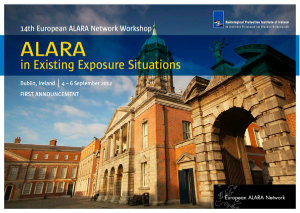
14th European ALARA Network Workshop, Ireland 4-6 September 201
« ALARA IN EXISTING EXPOSURE SITUATIONS »
The concept of “existing exposure situations” was introduced by ICRP in Publication No. 103 (2007), and is included in the revised European Basic Safety Standards Directive. It is defined as exposure situations that already exist when a decision on control has to be taken, such as those caused by natural background radiation and radioactive residues from past practices or events. Examples include radon in dwellings and buildings with public access, building materials and management of contaminated areas from past practices and post-accidents. Other situations such as exposure from cosmic rays and NORMs may also be included.
Optimisation is the key radiation protection principle for existing exposure situations, although it is not always clear how to apply this in practice. Consequently, the aim of the 14th EAN workshop is to focus on how the ALARA principle can be applied to the whole range of existing exposure situations. The Workshop will consider the wider principles and strategies that might be adopted, as well as the specific methods for implementing ALARA in practice.
This workshop will consist of presentations intended to highlight the main issues, and a significant part of the programme will be devoted to discussions within working groups. From these discussions, participants will be expected to produce recommendations on ALARA in existing exposure situations addressed to relevant local, national and international stakeholders.
Working Group Topics
- ALARA challenges and practicalities at the national and regional levels
- Considerations in choosing reference levels
- Economical, technical factors and endpoints of optimisation
- Societal factors and stakeholders engagement