4e-Aircrew request
4e-Aircrew request.pdf
The European ALARA Network (EAN) promotes the optimisation of radiation protection (keeping exposures As Low As Reasonably Achievable – ALARA) across Europe. It brings together professionals, regulators, and stakeholders to share experience, develop guidance, and support the practical implementation of ALARA principles in various sectors, including industry, medicine, research, and the environment.
4e-Aircrew request.pdf
4a-Ekoteh 15th EAN Worshop.pdf
1-2010 accounts and 2011 provisional 1.pdf
0-Agenda.pdf
The 28th issue of the EAN Newsletter has now been published and can be read in the Newsletter section. You can also download it as a PDF document.
The 3rd International MELODI (Multidisciplinary European Low Dose Initiative) Workshop was held from 2nd to 4th of November 2011 in Rome (Italy). The workshop in particular offered to the attendants the great opportunity to be informed about the latest updates on the low dose research issues, and to participate in the MELODI Low Dose Research […]

Download the 28th issue in PDF format
Editorial
By F. Vermeersch (EAN Chairperson – SCK-CEN Mol, Belgium), P. Croüail (EAN Vice-Chairperson – CEPN, France) and P. Shaw (EAN Secretary – HPA, UK)
Warning – This editorial was written before the recent dramatic events in Japan. The editorial board, and EAN Members would like to send their deepest condolences to the people of Japan, particularly those who have lost loved ones as a result of the earthquake and tsunami. Of course, we also have thoughts for the nuclear workers and firefighters who are trying to prevent an even bigger catastrophe, and for evacuees and other inhabitants of the regions affected by the radiological consequences of the serious accidents that occurred at the Fukushima NPP.
For many years, ALARA has often been considered simply as a tool that aims to balance the cost of (nuclear) workers’ protection against their radiological risks. This is a common simplification of the concept of optimisation, which has considerably evolved since the establishment of the concept of “reasonable practicability” or “reasonable achievability” – the so-called ALARP-ALARA principle – 70 years ago. This concept was first introduced into UK case law (Edwards v. National Coal Board in 1949) after a rockfall in a coal mine killed a worker. The original wording – which explains how ALARP/ALARA came to be interpreted – was: “risks must be averted unless there is a gross disproportion between the costs and benefits of doing so”. Consequently, until the end of the 80’s there was a focus on cost-benefit analysis as a means of radiological risk management. However, it is now recognized that ALARA is far more than this.
The optimisation principle applies to all exposure situations, in all domains of human activity where there is a potential radiological risk for people (workers and/or public). In the nuclear industry, the application of ALARA over 20 years, at an organisational and practical level, has been accompanied by a significant reduction in collective doses – often by a factor of between 2 and 10, for performing the same job or operation. In non-nuclear industries (e.g. industrial radiography, and NORM industries), important steps have been made, although ALARA awareness can still be improved [see G. Frasch, S. Neumaier et al., L. Garbarino – M. Calimero]. In the medical sector, the ALARA culture is not universally embraced in European countries, although there are encouraging signs that the message is starting to be heard [S. Christofides et al. and the EAN 13th Workshop announcement].
C. Lefaure In France there are currently more than 20,000 “Personnes Compétentes en Radioprotection” (PCR)/Radiation Protection Officers (RPO) and other radiation protection partners, such as occupational physicians involved in radiation protection. In the medical, research and non nuclear industry sectors, they can often feel isolated, not given appropriate recognition either within their organisations or by […]
ARPA FVG (Agenzia Regionale per la Protezione dell’Ambiente del Friuli Venezia Giulia) is organizing from 21 to 23 June 2011 in Udine (Italy) the conference "25 years after the Chernobyl accident: studies, remarks and recent findings". This conference addresses the latest scientific findings on the health and environmental impacts of the Chernobyl accident, to develop […]
G. Frasch
Federal Office for Radiation Protection – BfS, Germany
In Germany, about 2,500 workers are registered within the occupational category Industrial Radiography in the German Radiation Protection Register of the Federal Office for Radiation Protection (BfS). Industrial radiographers traditionally belong to one of the critical groups among radiation exposed workers. Their average annual personal doses are approximately in line with those from specific groups in the nuclear sector, nuclear medicine or interventional radiography in the medical sector and last but not least air craft crews.
The working conditions for workers in mobile industrial radiography are often exceptional. Their dosemeter evaluations frequently show smaller doses of typically one or two millisievert every month and occasionally higher doses from single incidents which, when summed, may occasionally lead to a dose limit being exceeded. In spite of the sometimes adverse working environment in on-site industrial radiography, the radiation exposure in this sector decreased substantially from 1998 to 2009 (Figure 1). It is interesting to study the change in the dose distributions over the years and to see how the fraction of workers in the different dose intervals changed and reached dose ranges which are seemingly hard to further reduce.
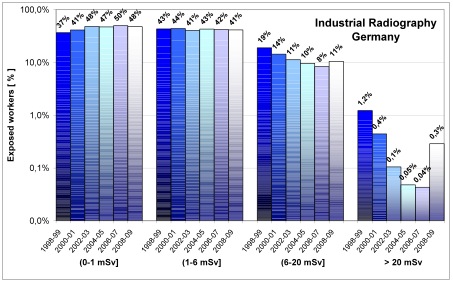
Figure 1. Change of frequency distribution of annual doses from 1998 to 2009
Cases > 20 mSv/yr: the systematic reduction in the number of workers exceeding the dose limit seems to have reached its optimum at a value below 0.5% of the measurably exposed workers. These remaining cases with overexposures seem to occur stochastically. The pattern of their monthly doses usually consists of numerous small dose values over the year, interrupted by one or two higher dose values that result in the dose limit being exceeded. The fact that there are now relatively few cases of the limits being exceeded, together with the observed characteristic pattern of monthly doses, would suggest that they cannot be avoided by applying generic ALARA measures; instead they should be addressed by specific analyses of incidents.
Cases between 6 – 20 mSv/yr: Optimisation can also be stated below the dose limit, in particular within the dose range of 6 – 20 mSv. During the course of the last decade about 10% of all measurably exposed workers remained within this dose range and it appears difficult to further reduce this value.
Cases between 1 – 6 mSv/yr: slightly more than 40% of the exposed radiographers stay relatively constant in this group.
Cases ≤ 1 mSv/yr: nowadays approximately half of all workers in this sector receive annual doses less than millisievert per year. This group necessarily increased as workers shifted from intervals with higher doses towards lower ones.
Up until 2003 there was a substantial decrease in the number of exposures that were received. In particular, the change in the intervals above 6 mSv indicates the results of a successful optimisation process. As the relative numbers remained comparably stable during the consecutive six years, it seems that optimization has lead to a level of exposure which cannot be further reduced.
By studying the changes in dose distributions it can be clearly seen the level at which systematic dose reduction has reached a level of exposure where stochastic processes (statistics) dominate. It also illustrates that a stage will occur where a generic technical and organisational measures approach to optimisation may no longer be effective and suggests that ALARA measures would be better focused on stochastically occurring single cases.
These stochastically occurring cases are probably less induced by insufficient technical protection measures; the reason lies more likely in the lack of ALARA culture, i.e. in the mind set of the workers and their management. The ALARA awareness of the workers gains importance when working on site and in absence of the direct supervision of a radiation protection officer (RPO). This ALARA awareness can be raised through briefings before and debriefings after the concrete exposure situation by the RPO. It is useful to utilize the information that is delivered from film dosemeters. Besides the individual dose, film dosemeters provide quite useful additional indicator information: together with the dose value and the exposure direction, the film can reveal specific exposure circumstances or operational mishaps that lead to exposure. Wrong handling of the film dosemeter can also be identified (Figure 2).
About 7% of all industrial radiographers are irradiated from the side and about 3% from behind. Both numbers are twice as high as the respective rates among all radiation workers and the rates remained relatively constant over the years. The analyses of the exposure direction may reveal operational mishaps or inattentiveness that lead to exposure.
Incorrect handling of the film dosemeter can also be an interesting indicator information: the rate of industrial radiographers who insert the film incorrectly into the dosemeter is seven times higher than the rate among all radiation workers. This indicates that there could be concerns regarding a group-specific lack of knowledge if not negligence in this sector rather than occasional inattention by inidvidual workers. In both cases, information about irregular dosemeter handling can be used for individual feedback in order to enhance the level of protection by raising ALARA awareness.
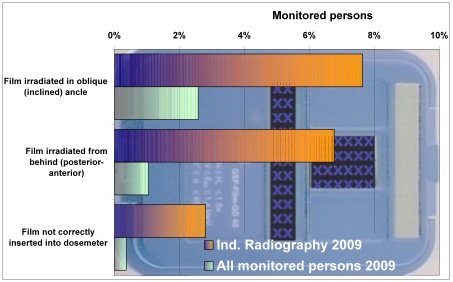
Figure 2. Mishaps or inattentiveness? What film dosemeters reveal.