The European ALARA Network

The European ALARA Network (EAN) promotes the optimisation of radiation protection (keeping exposures As Low As Reasonably Achievable – ALARA) across Europe. It brings together professionals, regulators, and stakeholders to share experience, develop guidance, and support the practical implementation of ALARA principles in various sectors, including industry, medicine, research, and the environment.

SFRP/COFREND working group on gammagraphy

In 2005 the French nuclear safety authority (ASN) requested the French Comittee of Non-Destructive Testings (COFREND) to work on improving radiation protection in gammagraphy. To perform this task COFREND asked for collaboration with the French Radiation Protection Society (SFRP). Thus in 2006-2007, 9 working groups on different topics (for instance, regulation, training, dosimetry, risk assessment […]

Read more

SMOPIE project

Following recommendation from the three first EAN workshops, the European Commission has set up a research project on the application of ALARA for the internal exposure. The SMOPIE (Strategies and Methods for the OPtimisation of Internal Exposure of workers from industrial natural sources) project came to its end in June 2004 and has generated important […]

Read more

EAN-NORM – European ALARA Network for NORM

ean norm logo new

    Context The principle of optimisation in radiation protection has been published by the ICRP in the recommendation No. 22 for the first time in 1973. Since 1980 the ALARA principle has been part of the European Basic Safety Standards and has been progressively introduced into national regulations. Nowadays the effective radiation protection practice […]

Read more

Second EAN-NORM Workshop

The European ALARA Network for NORM (EANNORM) is organizing its 2nd Workshop from 24th to 26th November, 2006 in Dresden (Germany). This Workshop will follow the spirit of the first edition. It will mainly be devoted to the dissemination of topical information/knowledge on good radiation protection practices concerning the NORM industru and other work activities. […]

Read more

12th EAN Workshop – Conclusions

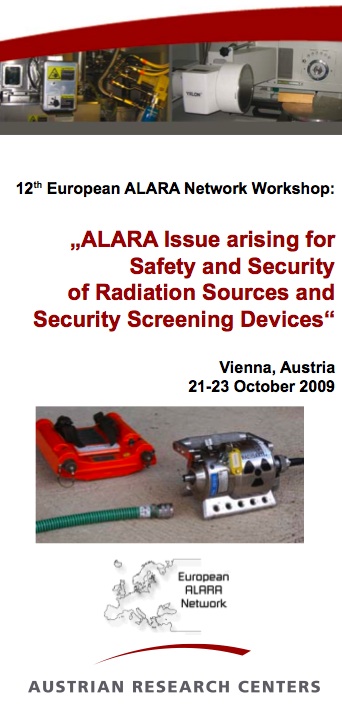
The 12th EAN Workshop took place in Vienna (Austria) from 21st to 23rd October 2009. It dealt with "ALARA issues arising for Safety and Security of Radiation Sources and Security Screening Devices". The full papers and PowerPoint presentations are downloadable in the Workshop section. NEW: The Conclusions of the 12th EAN Workshop are now available […]

Read more

Non-Medical Imaging Exposures

The Radiological Protection Institute of Ireland (RPII), the Department of Medical Physics and Bioengineering of the St. Jame’s Hospital and the Faculty of Radiologists, Royal College of Surgeons in Ireland are organising an International Symposium on "Non-Medical Imaging Exposures". It will be held in Dublin (Ireland) on 8-9 October 2009. As it is funded by […]

Read more

IM 2010 – Second announcement

The Greek Atomic Energy Commission, under the auspices of the European Commission and in co-operation with IAEA and EURADOS is organizing "the Individual Monitoring of Ionizing Radiation Conference". The conference will be held in Athens, from 8 to 12 March 2010. This conference presents a unique opportunity to keep up to date with the scientific […]

Read more

ALARA Newsletter – Issue 24

The 24th issue of the EAN Newsletter has now been published and can be downloaded in the Newsletter section. Contents of the Issue Extremity dose to nuclear medicine technologists in routine clinical practice with 18F-FDG, The European Radiation Protection Authorities Network, Summary of the 1st ARAN Workshop: "Imrpoving Radiation Protection in Industrial Radiography", 4th RECAN […]

Read more

Issue 24 – February 2009

pdf.pngDownload the 24th issue in PDF format

Editorial

The implementation of the ALARA principle in the medical and industrial fields is certainly one of the most challenging issues that health physicists and RP professionals will have to deal with during the next decade. Numerous presentations made on these topics at the IRPA 12th Conference in Buenos-Aires have confirmed this. It raises even more crucially the need for enhancing radiological protection culture, especially outside the nuclear sector.  Thus, the initiative taken by the Radiological Protection Societies to establis h a dedicated working group to prepare IRPA Guiding Principles on the improvement of radiological protection culture worldwide is very welcome. Moreover, the integration of the revised ICRP Recommendations for the system of radiological protection into national regulations will undoubtedly reinforce the role of optimisation (ALARA) in reducing occupational and public exposures.   Maybe we can say that the RP profession is reaching a major turning point in the movement toward a common way of doing, organizing, and managing radiological protection: towards shared ethics?

Read more

12th EAN Workshop

"ALARA issues arising for Safety and Security of Radiation Sources and Security Screening Devices", Vienna, Austria, 21-23 October 2009
ean12.jpgpdf.pngDownload the Conclusions of the Workshop (without references)
pdf.pngDownload the Conclusions of the Workshop (with references)
pdf.png
Download Special Issue of the ALARA Newsletter dedicated to the Workshop

Background and objectives
Radiation protection has always included security-related provisions, for example measures to prevent the unauthorised use and illegal transfer of sources, which have contributed to the overall system of radiation safety. In recent years, however, interest in security issues has dramatically increased and the challenge is to ensure that safety and security measures are designed and implemented in an integrated manner so that security measures do not compromise safety and safety measures do not compromise security.

The aim of the Workshop was to consider how the implementation of ALARA, in terms of planned and emergency exposure situations, involving worker and public doses, is affected by the introduction of these new security-related measures. In the case of new equipment and procedures, there is also the question of whether exposures arising from security screening devices can be justified. In addressing these issues, the Workshop aimed to consider how an optimum balance between protection, safety and security can be achieved.
Read more